TRC Read to Kids

Welcome to The Reading Connection’s blog, where you’ll find the best guidance on reading aloud to kids. Whether you are a TRC Read-Aloud volunteer, parent or student, the book themes and crafts ideas, child development guidelines and recommended websites will expand your world. For 25 years, The Reading Connection has worked to improve the lives of at-risk kids by linking the magic of reading to fun experiences that inspire a passion for learning. Visit our website at www.thereadingconnection.org.

Monday, February 6, 2012

To Snack or Not to Snack

That seems to be the question.

Some TRC sites always include a snack in their Read-Aloud. Others never do, and yet there are some that include a snack now and again as a special treat. When carefully planned, snacks can add a wonderful component to your Read-Aloud.


Why? 
  • Kids always seem to be hungry, and feeding them is a good way to avert low blood sugar grumpiness. Our Read-Alouds take place in the evening, a prime tummy-rumbling time of day. Some teams even provide snacks at the beginning of their Read-Aloud to settle the kids and quiet growling tummies. Volunteers pass out the snack and start reading to the kids as they nibble.
  • Cooking with the kids allows for hands-on fun, so assembling a snack can sometimes serve as your activity.
  • Snacks related to your Read-Aloud theme can add an extra-special dimension to the experience.

How? 
  • Be sure to make sure your site allows you to serve a snack. Check with site staff before bringing food to a Read-Aloud. Also ask about rules regarding where food may be served. Some sites allow kids to eat at the Read-Aloud, but they may not allow food to be removed from that room.
  • Ask site staff about food allergies and sensitivites, and just to be sure, avoid nuts of all kinds and anything sesame. (Use sunflower seed butter instead of peanut butter.)  
  • Never use snacks as a behavior management tool -- do not offer it as a bribe or withhold it as punishment. Many of the kids we serve may have experienced anxiety about not having enough to eat. If you bring a snack, everyone at the Read-Aloud gets to enjoy it.
  • Try to make snacks healthy as well as fun. Keep in mind that our Read-Alouds happen either right before or right after dinner. 
  • Many sites have access to a sink and sometimes a microwave. You can also bring an electric skillet or kettle, toaster oven, popcorn maker or electric grill with you.
  • Clean up very carefully after yourselves.

What?

Snacks don't have to be related to the Read-Aloud, but it sure is fun when they are! Here are some ideas from your fellow volunteers and TRC staff:
  • Fruit kabobs for a caterpillar theme (thread grapes, melon balls and berries on a skewer or piece of uncooked spaghetti to make a caterpillar). Other caterpillar examples can be found here. 
  • English muffin pizzas for a pizza theme
  • Ants on a log (celery, raisins and sunflower seed butter or cream cheese) for a picnic or bug theme
  • Bird-seed trail mix for a bird theme (sunflower seeds, pumpkin seeds, dried cranberries, cheerios)
  • Fruits and veggies of many different colors for a rainbow theme
  • Air-popped popcorn for a popcorn, native American or movie Read-Aloud (TRC has an air popper you can borrow)
  • Pretzels as the in-flight snack for a flying or travel Read-Aloud
  • Cocoa and ginger bread for winter themes
  • Sugar snap peas, sprouts or hard boiled eggs for spring themes
  • Fruit smoothies for summertime themes
  • Apples and pumpkin seeds for fall themes
You get the idea. Let the books inspire you. Get the kids involved and add taste to the senses you engage at your next Read-Aloud!


To receive credit for this online training, please fill out the form here.

Tuesday, January 31, 2012

No-Supplies Activities

Uh-oh.  Got caught without the supplies you were counting on for your Read-Aloud activity? No matter how carefully you plan, some day your team may find itself with a room full of kids and no supplies for your activity. No need to stress!  Here are some ideas for activities that work off all that creativity in the room.
If he can get this excited about a cherry tomato, he'll love your no-supplies required activity!

Here are some ideas for activities that don't require anything more than time, imagination and what's already in the room.

Games can connect to the theme and let the kids get out their energy.

A good round of "Duck, Duck, Goose" or "Musical Chairs" might be just the thing if you sense that your audience is antsy and full of energy. You can change the name of the game to make it match with your theme. Play "Dog, Dog, Cat" for a theme about pets or dogs or cats. Other games such as "Sharks and Minnows" can be adapted as well -- for example, try reading The True Story of the Three Little Pigs and play "Pigs and Wolves." For games like this, feel free to take the game outside if there is space available and the staff okays its use.  

For a calmer group, try a game of "Telephone" starting with a sentence about the story. If the group is large, form two groups and start each group with the same sentence. The kids will think it's hilarious to hear the different results.

Create games within stories or poems.

After reading the story once, assign a motion to a certain word -- for example, jump every time you hear "Not I." Read the story again with the first motion, and then add a second. This time, jump every time you hear "Not I," and spin around every time you hear the word "bread." The third time...etc. This will work better with shorter stories, and will work especially well with stories or poems containing repeated words, lines or verses.

Reenact a story.

After you've read the story the first time, ask the kids to tell it back to you. Then, read it a second time, but be sure to ask them what's coming next before turning the page! After a second read-through, assign parts and ask them to act out the story. You may want to do it more than once so that different kids get to play different roles, or with more than one story if the audience is older and picks up the story more quickly. 

Variations on this activity include the following:

  • Ask the kids to act out the story without words. Then after they've done that, have them do it in double time. 
  • Pick a funny prop from whatever is already in the room (a chair or a stuffed animal) and have your actors incorporate it in to the story.
  • In a group, ask the kids to make up an alternate ending to the story. Prompt them by asking "what if..." questions. What would have happened if Little Red Hen's friends had agreed to help her bake the bread in the first place, or if Cinderella had refused to leave the ball at midnight? Ask individuals or pairs to come up with alternate endings, and then act them out.

For other ideas, check out this list of icebreakers and group games. You may have to adapt some for a younger crowd, but it's a great place to start.

Post by The Reading Connection intern Anna McCormally.


To receive credit for this online training, please fill out the form here.

Monday, January 23, 2012

Fun, Not Frustration: TRC Game Plan for Read-Aloud Success (Part 1)

Do you ever feel like the odds are stacked against you? Engaging all the kids at your Read-Aloud in a positive way and managing disruptions is a challenging task. To help you, TRC has drawn up a game plan, with strategic plays to put you on the path to victory. Here’s the first part of the plan:


Play 1: Break into small groups after your first book or two. Divide the kids up by age, interest or need. Have one or two volunteers work with each group to provide a more personal and interactive reading experience. Split up siblings or other kids if they are edgy. If one child is especially bouncy or cranky, assign one volunteer to work with her one-on-one.

Play 2: Use space to your advantage. Arrive early enough to arrange the room to allow volunteers to sit with the kids instead of across a table from them, to allow for small groups to form and sit apart from each other, and to accommodate lots of physical movement.

  • If need be, move tables out of the way to create an open area where you can work with the kids. Just remember to put tables back where you found them at the end of your Read-Aloud.

Play 3: Incorporate physical movement into your Read-Aloud. The kids have been sitting still all day. They need to move. Now that you have space to accommodate it, play games, use activities that involve movement, or do a calmer or energizer with the kids during the Read-Aloud.


    An ARHA volunteer leads the kids in stretches before reading.


                                 Play 4: Stay positive. Good vibes foster good behavior.

                                • Redirect inappropriate or outrageous behavior. Meet disruptive behavior with a positive, personally engaging response. When a kid is acting out, often what he or she needs is caring, constructive attention. Channel challenging behavior by giving the child a job during the Read-Aloud. Page turner, sentence finisher, rhyme maker, illustration describer, activity setter-upper. You get the idea.

                                • Catch kids being good. Positive reinforcement works wonders. We all know how good it feels to be told we're doing a good job.
                                These plays help meet the kids’ needs (emotional, physical, social, intellectual), and will go a long way toward keeping everyone happily engaged.

                                Check out the next TRC EDU in February for Part II of Fun, Not Frustration: TRC Gameplan for Read-Aloud Success for more winning plays.


                                To receive credit for this online training, please fill out the form here.

                                Tuesday, January 17, 2012

                                Report Feature: Flight Read-Aloud

                                The kids at SOME's Independence Place were thrilled when they found out they were hopping a "flight" to attend The Reading Connection Read-Aloud on a recent week. 

                                Each kid and adult got their very own boarding pass (found here or here) for the flight and lined up to be checked in (name tag and all)! This made the traditional set-up process of getting a name tag and taking attendance more fun for the kids. Each kid stated their name, then got a name tag and a "beep" as we pretended to scan each boarding pass. After check-in, each kid got settled into their own carpet mat "seat" and secured their imaginary seat belts before take off.  

                                Volunteers discussed where the kids wanted to fly and the kids enjoyed discussing the times they have seen or flown in airplanes.  

                                We read books about a variety of flying objects including Take Off! by Ryan Ann Hunter and Walter the Farting Dog by William Kotzwinkle and Glenn Murray.  

                                After reading, the kids decorated wooden airplanes and butterflies before landing and disembarking to get a Read-Aloud giveaway book.  

                                Overall, a trip worth taking!


                                To receive credit for this online training, please fill out the form here.

                                Monday, January 9, 2012

                                Dealing with cancellations

                                You and your team are all set to go with a terrific Read-Aloud. And then it snows. 

                                Since it's the season when snow storms are most likely to be a factor with Read-Alouds, here is the snow policy.

                                TRC follows the local school systems in determining whether or not to cancel a Read-Aloud. If school was cancelled or if all evening activities are cancelled on the day of your reading, Read-Alouds are cancelled. Sites in Alexandria follow Alexandria City Public Schools, Arlington sites follow Arlington Public Schools, DC sites follow DCPS and Fairfax County sites follow FCPS. When you realize your Read-Aloud needs to be cancelled due to snow, contact your fellow volunteers and your site to be sure everyone has been notified.

                                We hope that Read-Alouds are never cancelled, understanding that it is disappointing for volunteers who have planned ahead and are looking forward to their night with the kids. But experience has shown that Read-Alouds sometimes need to be cancelled for non-weather reasons such as sickness in the shelter, no staff on hand, or a scheduling conflict at the site. Sometimes teams find that team members needed to cancel before finding substitutes. If only one volunteer can attend a Read-Aloud, it must be cancelled. 


                                Although it is disappointing to volunteers and kids, there's usually nothing we can do about a last-minute cancellation. On the positive side, your Read-Aloud for your next session is already planned. Renew the library books and keep needed supplies where you'll remember them next month. 


                                If you offer to substitute on other teams at your site, you may be able to prevent a cancellation. By doing so, you can still enjoy your once a month visit with the kids and you help out a fellow volunteer.


                                To receive credit for this online training, please fill out the form here.

                                Friday, January 6, 2012

                                Book Feature: The Snowy Day

                                Snow seems to be evading us so far this winter, but that doesn't mean your Read-Alouds also need to be snow-free. This year, the literary world is celebrating the 50th anniversary of The Snowy Day by Ezra Jack Keats. The Washington Post gave the book a nod in the Sunday, January 1, 2012 edition. The Snowy Day broke a color barrier in children's literature, featuring the first African American child protagonist.

                                Keats' book follows a young boy named Peter through his exploration of a fresh snowfall. It's a fun book to read just after a snowstorm or in anticipation of one. Talk with the kids at your Read-Aloud about their past experiences with snow. Most will remember the past two winters when we had very different amounts of snow. Start a discussion by asking the kids if they have done the same things that Peter does in the snow.

                                The illustrations of this book are also very special. The Snowy Day won the 1963 Caldecott Medal given "to the artist of the most distinguished American picture book for children" each year. Keats used collage to create the snowscape, Peter and his surroundings. For more information about Ezra Jack Keats and The Snowy Day, check out its entry on the Children's Book-A-Day Almanac from last March.

                                To expand on this book, Reading Rockets has created a Family Literacy Bag based on The Snowy Day. These bags are intended for parents to use with their children, but will work just as well for TRC volunteers to use as Read-Aloud starters.  

                                The Literacy Bag includes instructions for perfect Read-Aloud activities such as making a collage snow scene and homemade snowflakes as well as an ice melting experiment. The information packet also includes companion titles such as Snow Is Falling by Franklyn M. Branley.

                                There are 19 Reading Rockets' Family Literacy Bags on a variety of topics. When you're looking for something different for a Read-Aloud theme, check here for some pre-fabricated sessions.


                                To receive credit for this online training, please fill out the form here.

                                Tuesday, December 20, 2011

                                Active Reading: Mem Fox Shows How and Why

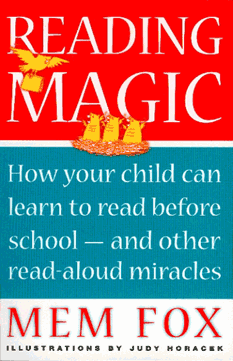
                                One of TRC's favorite authors, Mem Fox, has written over 30 children's books and five nonfiction books for adults.  Fox's Ten Little Fingers and Ten Little Toes is a fabulous read-aloud choice. Her nonfiction book for adults, Reading Magic: Why Reading Aloud to Our Children Will Change Their Lives Forever shares TRC's read-aloud approach (do it as often as possible!) and her website is full of suggestions and how-tos for reading aloud. 


                                On the website, you can hear Mem read aloud from a section from her book titled "And do it like this."

                                "Reading aloud," Mem says, "is not quite enough -- we need to read aloud well."

                                Research shows that children need to hear 1,000 stories read aloud before they can learn to read themselves. Mem's philosophy is that for a child to sit still long enough to hear 1,000 stories, what they're hearing needs to be good! Just reading isn't enough; you need to read actively. 

                                What is active reading? For Mem, it means being aware of your expression, your body position and make eye contact with your audience. Make faces, change your tone and the speed of your reading. Hear her elaborate on active reading here.

                                When Mem reads, she emphasizes the music of the human voice. Change your pitch, go up and down. Whisper and shout! Speed up and slow down with the story. Make it exciting! 

                                Other than putting your audience to sleep, the most important thing to avoid is being patronizing. Mem cautions: "We have to make a conscious decision never to talk down to children."

                                To hear the rest from a professional reader, go to Mem's website and listen for yourself. She reads to adults from Reading Magic the way children should be read to -- like she's having a great time. 

                                Another great part of Mem's website is her ten read-aloud commandments. Not all can be applied to our Read-Alouds, but here are some that can:
                                • Read aloud with animation. Listen to your own voice and don’t be dull, or flat or boring. Hang loose and be loud, have fun and laugh a lot.

                                • Read with joy and enjoyment: real enjoyment for yourself and great joy for the listeners.

                                • Let children hear lots of language by talking to them constantly about the pictures, or anything else connected to the book; or sing any old song that you can remember; or say nursery rhymes in a bouncy way; or be noisy together doing clapping games.

                                • Look for rhyme, rhythm or repetition in books for young children, and make sure the books are really short.

                                • Play games with the things that you and the child can see on the page, such as letting kids finish rhymes and finding the letters that start the child’s name and yours, remembering that it’s never work, it’s always a fabulous game.


                                To receive credit for this online training, please fill out the form here.