TRC Read to Kids

Welcome to The Reading Connection’s blog, where you’ll find the best guidance on reading aloud to kids. Whether you are a TRC Read-Aloud volunteer, parent or student, the book themes and crafts ideas, child development guidelines and recommended websites will expand your world. For 25 years, The Reading Connection has worked to improve the lives of at-risk kids by linking the magic of reading to fun experiences that inspire a passion for learning. Visit our website at www.thereadingconnection.org.

Monday, December 16, 2013

Holiday shopping

Are you still looking for the perfect gift for the kids and adults on your list? Lucky for you, The Reading Connection (TRC) is here to help.

Books are a great gift for kids of all ages. Build a love of reading from the very start by giving infants and toddlers board books that were made just for them. Board books can stand up to the heavy love that babies give them.  They are resistant to tears and being chewed on, since their pages are made of cardboard.

Picture books can appeal to young people from toddlers and teens, depending on their design and content. Take the time to read through a picture book that catches your eye. You might be surprised at the wit or depth contained therein. Don't hesitate to ask a bookseller to recommend her favorite titles for the children you have in mind. 

"Early readers" are designed to help beginning and newly independent readers feel confident reading on their own. You'll know these books by the distinctive 6-inch by 9-inch size. Reading books on favorite subjects is a strong motivator for new readers; it's well worth your time to seek out early readers on your young reader's current passion. 

Novels and nonfiction books for older kids come in all shapes and sizes. Find out what gets your recipient fired up and go from there.  Some kids will want the newest book in their favorite series, and these series are available for all ages (one current favorite is Diary of a Wimpy Kid: Hard Luck). Ask a booksellers advice about the best choices for the age and interests of the child for whom you're buying. 
For the readers on your list, check out the many lists of top books of the year. Some of our favorites from this year are

Middle grade: Wonder and One Crazy Summer
Young adult: Allegiant and The 5th Wave

You can also find year-end recommendations at Goodreads and Indie Bound or on our wish list.  When buying books, please support your local independent bookstores, who support TRC.

Consider honoring friends and family who love books by helping to provide free books and literacy-rich experiences for at-risk kids and families. A $10 donation to The Reading Connection can purchase and deliver a book to the home of one of our Book Club kids. 

Monday, December 2, 2013

Winter Wonderland Crafts

Cold and snow outside make excellent reading conditions inside. If you are looking for something hands-on to do after you read about snow or polar regions, go play in the snow! But if you don't have any snow, and you don't want to make another paper snowflake, try these frosty crafts. (Click on the name of each craft for a link to instructions.)


Marshmallow Snowman
When it’s too cold to build a snowman outside, craft one inside using mini marshmallows – and you don’t have to worry about this guy melting any time soon. This craft leaves room for a tasty snack afterwards!


Paper Plate Penguin
Making this adorable fellow is a simple but fun craft for a young crowd. With just two paper plates, scissors, glue and markers, everyone can make a penguin friend.


Popsicle Stick Snowflake 
Forget cut-paper snow flakes. Go for 3-D flakes made with craft popsicle sticks. Decorate the popsicle sticks with white buttons, beads, glitter or anything else you can find at the bottom of your craft bin.


Handprint Polar Bear
Handprints can turn into just about anything, including this fuzzy friend from the North Pole. Blue paper, white paint and a marker are all you need for this frosty craft.


To receive credit for this online training, please fill out the form here.

Monday, November 25, 2013

Use yoga to help kids focus at Read-Alouds

How can you get kids to settle down when they're full of energy? Try using some simple, kid-friendly yoga moves.

An article entitled How Poverty Affects Classroom Engagement in the May 2013 issue of Educational Leadership discussed the benefits of yoga and movement on kids’ focus and behavior. 

“Having students engage in slow stretching while taking slow deep breaths can increase their oxygenation. Yoga training has been shown to increase metabolic controls so children can better manage themselves.”

“Recess and physical education contribute to greater oxygen intake and better learning (Winter et al., 2007)....The use of games, movement, and drama will trigger the release of glucose, stored in the body as glycogen.  Proper glucose levels are associated with stronger memory and cognitive function.” 

The following yoga moves are taught in the Yoga4Classrooms™ training, created by Lisa Flynn. Use these moves alone or in combination with others to energize or calm kids at transition times.


Yoga Moves for Calm

Bumble Bee Breath
  • Take a slow, deep breath in through your nose before exhaling out “hmmmmm” as long as possible. 
  • First try this with your eyes open, and then with your eyes closed. Then try blocking your ears to make your head fill with the humming sound.
Flying Bird Breath
  • Breathe in slowly while lifting your arms out to sides and then up over your head with your palms facing up.
  • Slowly exhale as you lower your "wings" down to your sides, palms facing down.
Cat
  • Sit up tall with your fingers laced together. 
  • Turn your palms out and inhale deeply while extending your arms straight up in the air.
  • Exhale, round your shoulders, push your spine back and push your arms in front of you.


Yoga Moves for Energy

Waterfall
  • Stand up tall with your feet under your hips.
  • Inhale as you bring your hands in front and above your head and lean slightly backwards.
  • Exhale and lean forward, letting your arms swing down like the water over a waterfall.
  • Inhale and bring the water (your arms) back up to the top and then have them crash down again.
Washing Machine
  • Stand up tall with your feet under your hips and let your arms hang loose by your sides.
  • Turn your upper body from side to side and allow your arms to wrap around you as you twist.
  • Once you are all clean, turn off the washing machine and slowly come back to standing still. Finish with Flying Bird Breath to dry out.
Twisting Star
  • Spread your feet wide apart and stretch your arms out to the side. You should look like a five-pointed star.
  • To make the star twinkle, reach your right hand down to the ground between your feet with your left arm pointing up. Stay there for a breath or two and then switch sides.
  • You can also make the star twinkle by going back to the basic star position and rocking from side to side while balancing on each foot. You can sing "Twinkle, Twinkle Little Star" while rocking or saying “twinkle, twinkle, stop.”  Freeze and balance when you say stop.

To receive credit for this online training, please fill out the form here.

Monday, November 18, 2013

This is your brain on poverty

The topic of the TRC Volunteer Seminar held on October 30, 2013 was "This is your brain on poverty." Lib Gillam, a therapist at the Center for Alexandria’s Children, addressed the effect of being homeless on growing children.    
Ms. Gillam began her presentation by describing the Circle of Security. This behavioral model and corresponding graphic provide the best ways of interacting with a child while attending to his needs.  


As the responsible adult at a Read-Aloud, a volunteer is essentially a child’s caregiver for that period of time. Kids need the volunteers to provide a safe haven and secure base where they can feel safe, comfortable and appreciated. The Circle of Security graphic above shows some specific ways in which volunteers can help kids feel safe and secure so the kids can eventually explore and learn new things. Over time, with such support, kids can work through their feelings.

Next, Ms. Gillam described the physiological effects of homelessness and poverty on developing children and the ways in which children's behavior can be affected. When under stress, the body floods the brain with adrenalin and the body and brain go into fight-or-flight mode. Kids growing up in stressful conditions find their bodies persistently in crisis mode. 

Lacking a sense of control and safety in their everyday lives, children living in homelessness and poverty may exhibit changes in their behavior. Ms. Gillam pointed out various triggers and common responses from children under stress. Some examples are:
  • loss of security: she may become hyper-vigilant or emotional
  • loss of control: he may try to take control or act out for a limit to be set
  • loss of attachment from someone: she may become clingy or avoid contact
  • shaken self-concept: he may become withdrawn or look for a role in a group
  • anxiety from adults: she will carefully assess adult enthusiasm versus tension

Because the bodies and brains of Read-Aloud kids are likely in an emotionally-charged fight-or-flight mode, it is important to connect with them emotionally and help them feel safe. Volunteers first need to build a relationship with the child before directing or correcting their behavior. According to Ms. Gillam, the best method is to "Connect, then correct.”

While working with kids under stress may seem daunting, the good news is that positive experiences make a difference in the brain.
Experiences that strengthen connections

  • are frequent, regular and predictable,
  • occur in the context of a warm, supportive relationship,
  • are associated with positive emotions (fun, excitement, humor, comfort),
  • involve several senses and
  • are responsive to the child’s interests or initiative.
Creating a TRC Read-Aloud that is fun, predictable and safe helps kids switch out of fight-or-flight mode and create new, positive connections in the brain. 

When asked what elements of this talk they would use at their Read-Alouds, TRC volunteers said, "Now we understand where kids are coming from." Realizing how consistency supports kids under stress and that the kids need to have fun with them gives the volunteers an informed perspective to planning and conducting Read-Alouds.


To receive credit for this online training, please fill out the form here.

Monday, November 4, 2013

Resilience

What is that special something that enables a person to survive and sometimes even excel under challenging circumstances? What factors or resources strengthen or bolster a child? The September 2013 issue of Educational Leadership explored the concept of resilience and its role in learning.
     
A study described in the issue, Resilience and At-risk Children and Youth, explains that resilience has two parts: "1) An exposure to great risk; and 2) Corresponding factors that help promote positive outcomes or reduce negative outcomes." (p. 3) At-risk children, like the kids TRC serves, often experience multiple risk factors. When these factors occur together, they multiply the behavior problem. For example, "children in families that had accumulated two risk factors showed a more than fourfold increase in behavior problems" when compared to families with one stress factor. (p.4)

In the same issue of Educational Leadership, Nan Henderson’s article, Havens of Resilience, describes protective factors that help kids develop their resilience. The author created a graphic, the Resiliency Wheel, that represents the resiliency-building conditions that have been identified through research.

 Nan Henderson's Resiliency Wheel
from Educational Leadership, September 2013


According to Henderson, the most important environmental protective factor is providing caring and support. The other five factors grow out of it.


The structure and content of TRC's Read-Aloud program provide several protective factors that help kids weather challenging situations. 

At the beginning of each Read-Aloud, volunteers set and communicate high expectations and also set clear and consistent boundaries when they remind kids about TRC’s Promises (Listen, Respect, Cooperate and Have Fun). Consistently reminding the kids about the Promises and enforcing them every week helps the kids know what to expect and reduces their stress.

Every time a volunteer asks a child for his opinion about a story or encourages her to choose a book to take home, the volunteer is expressing his perception of the child as a reader, another high expectation.

By taking the time to ask questions, listening to what kids say about the books being read aloud and providing engaging activities, volunteers create opportunities for meaningful participation and teach life skills.

Getting to know the children and encouraging positive interaction with their Read-Aloud peers increases prosocial bonding. Meeting weekly throughout the year creates a community of readers that cares for and supports each other. This social aspect of the Read-Aloud experience helps kids feel connected to other readers in their neighborhood and to the reading community at large.

The hour each week that TRC kids spend at a Read-Aloud supports their growth as readers and provides them with a positive, consistent, engaging environment that fosters their resilience. Reading with volunteers provides a healthy escape from stress and creates a supportive, caring community that the kids can count on. TRC's Read-Aloud program helps kids become frequent and passionate readers, but it also does so much more in the process.

Nan Henderson, Havens of Resilience, Educational Leadership September 2013, Vol. 71 No. 1, pp. 23-27.

Jan Moore,  Resilience and At-Risk Children and Youth, National Center for Homeless Education, April 2013.

To receive credit for this online training, please fill out the form here.

Tuesday, October 22, 2013

Worms Read-Aloud

A few weeks ago, the volunteers at Sullivan House held a Read-Aloud about worms. They brought in live worms and let the kids get some hands-on experience while reading about these slimy creatures.  

The volunteers began their worm night by reading Diary of a Worm by Doreen Cronin. This humorous picture book details the life of a worm kid diary format, including eating his homework and having a hard time doing the Hokey Pokey. While keeping the kids laughing, this book also teaches a few interesting facts about worms. 

They read aloud Yucky Worms by Vivian French next. In this book, a little boy and his grandma find a worm in her garden. The boy thinks the worm is yucky until his grandma teaches him all the interesting things she knows about worms.

After reading both books, the group discussed some of the facts it had just learned from the books, including the following:  
  • Worms' heads are pointed and their tails are rounded. 
  • Worms are segmented and this helps them move through soil. Their movements loosen the soil and aerate the ground.
  • Worms eat dead organic material. They also eat small amounts of garbage and small rocks.
  • Their waste fertilizes the soil. 
  • Worms can regenerate segments of their bodies.
  • Some worms can grow up to 22 feet long.
  • Worms do not have lungs. They breathe through their skin.
  • Worms have no eyes.
After reading in a large group, the volunteers passed out real worms and magnifying glasses, and gave the kids time to examine the worms. This exercise triggered many questions from the kids, which they discussed with the volunteers. They also read some additional books in smaller groups. After washing hands, the group enjoyed a snack of gummy worms.

The volunteers brought a wide variety of fiction and nonfiction books to read in small groups. Some of their favorite additional titles were Inch By Inch by Leo Lionni and Wiggling Worms at Work by Wendy Pfeffer.


If you're not up for digging up your own worms, you can purchase 12 night crawler worms at PetSmart or other pet supply stores for about $4.


To receive credit for this online training, please fill out the form here.

Tuesday, October 8, 2013

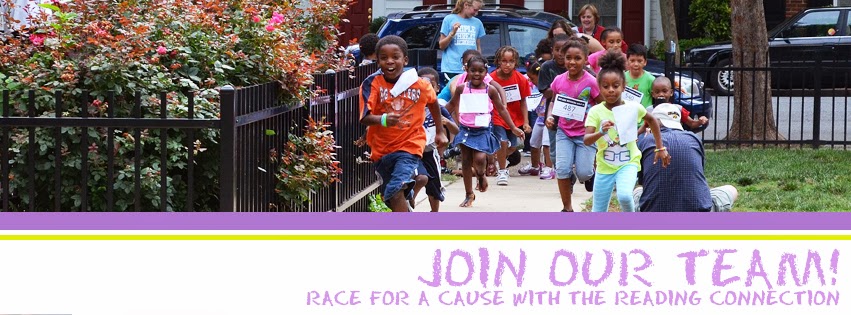
Race for a Cause


The 2013 Acumen Solutions Race for a Cause 8k & 1-Mile Fun Run is this Sunday, October 13, 2013. We hope you'll join us for an October morning of outdoor fun. 
  
By registering to run or walk in the 8k or 1-Mile Fun Run, you will support TRC's important work. This is a great opportunity to invite friends, family members and colleagues to join you in supporting TRC. 
  
The race begins at 8:00 a.m. The start and finish line is on North Quincy Street, near the intersection with Wilson Boulevard, in Arlington, VA and just a few blocks from TRC's office. 

When you register for the race at www.theraceforacause.com, remember to select TRC as your nonprofit choice. Make sure you register soon because registration closes on Thursday, October 10 at 9:00 p.m
  
If you already have registered for this year's race, thank you. If not, this is the time to step up and support TRC! If you have other plans for Sunday and cannot be there, you can still help by sponsoring a child from our program who wants to participate.

We hope you'll join us for a fun, healthy and rewarding Sunday morning. Your support will help TRC in its mission to create and sustain literacy-rich environments for at-risk children in our community.

We look forward to seeing you there!